Woke up to a rock-solid bird? You’re not alone. It’s easy to forget to thaw your bird. But that doesn’t mean Thanksgiving is ruined! Here’s how to cook a frozen turkey safely using time-and-temp science. We have the tips you need for a picture-perfect turkey direct from frozen, in a pinch.
Extra dinner guests show up unexpectedly? Forget to pull the turkey from the freezer? Whatever the reason why your turkey is still frozen solid, don’t fret. You should never cook a partially frozen turkey because the outer layers of turkey will become a desert while the frozen center thaws and comes to a safe temperature, but if thawing isn’t an option, a completely frozen turkey can still be the centerpiece of your holiday meal.
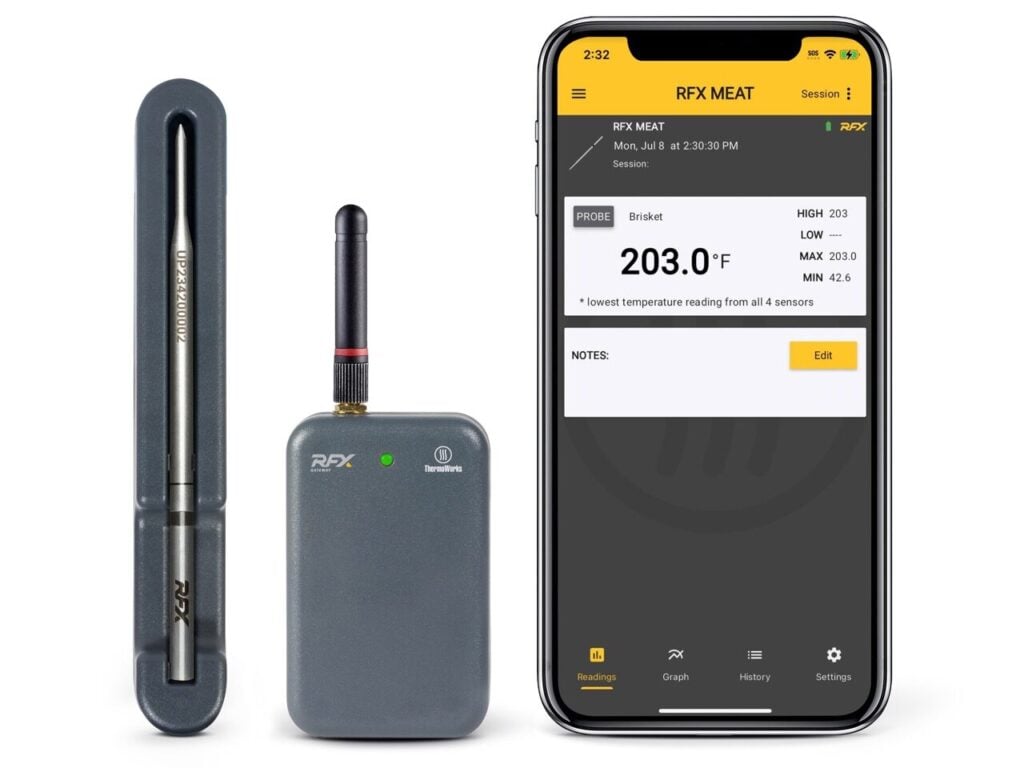
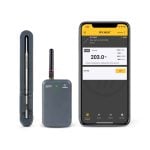
Note: If you want to cook a turkey from frozen, RFX MEAT™ Wireless Thermometer will make the whole thing go a lot better!
Benefits of Cooking a Frozen Turkey
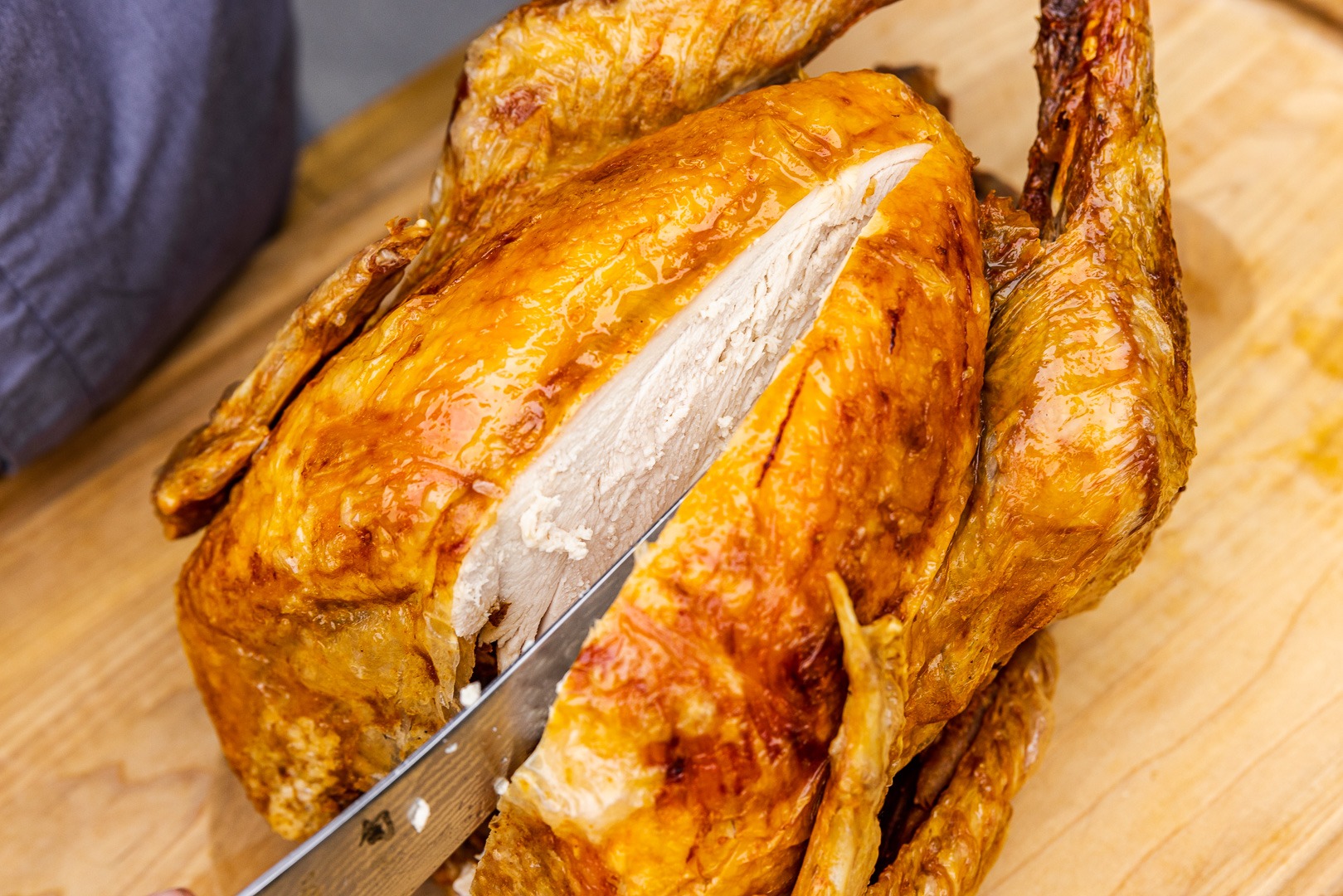
Won’t the white meat overcook? Actually, when you cook a fully frozen turkey, the breasts are the largest muscles on the turkey and will take the longest time to thaw, cook, and to come to their pull temperature. The relatively smaller legs and thighs will thaw and cook faster from their frozen state, giving them more time for connective tissue to dissolve. The white and dark meat will cook properly and you may find your turkey is less likely to have dry breast meat than when you cook a thawed turkey.
Refrigerator Space: No thawing means no turkey taking up space in your fridge and no stressful thawing process.
Challenges and Considerations with Frozen Turkeys
A Longer Cook Time: Just as you would expect, a frozen turkey will take longer to cook than one that is thawed before being placed in the oven. Plan on it taking approximately 50% more time to cook completely—so be aware that your dinner may be served later than originally planned. For example, our 14-pound turkey cooked in 5-3/4 hours.
Oven Temp to Set? Set your oven temperature too low and the outer meat will overcook. Set it too high and you’ll end up with the same problem encountered when cooking a partially frozen turkey (dry, overcooked outer breast meat when the thermal center finally reaches your pull temp). A moderate oven temperature of 325°F (163°C) is the sweet spot.
A: No. Remember that the USDA recommends that turkey needs to be out of the danger zone within 4 hours of the turkey being taken out of the freezer or refrigerator. The temperatures of smoking (225-275°F [107-135°C]) are too low to cook a frozen turkey to a food safe temperature within 4 hours.
Q:Can I deep-fry a frozen turkey?
A: NO!! NEVER. The dramatic temperature difference between the hot oil and the frozen turkey will cause violent boil overs. Oil spilling over the top edge of the pot could ignite with the flame from the burner below. Trying to deep-fry a frozen turkey is what causes explosions. The turkey must be COMPLETELY thawed and patted dry before being deep-fried. Read our post, Deep Fried Turkey Made Safe and Delicious for more information on how to safely deep fry a turkey. Just don’t do it with this one!
How does it taste?!?
Is it any good? Yes! In fact, because it is cooked to temp, not time, this frozen-to-cooked turkey is actually quite juicy. It’s better than a properly thawed turkey cooked without temperature monitoring, to be sure! In fact, the results are good enough that if you have the oven space on Thanksgiving, you might actually plan on cooking your bird this way. Happy cooking!
Here’s how to take a turkey from a block of ice to a picture-perfect centerpiece:
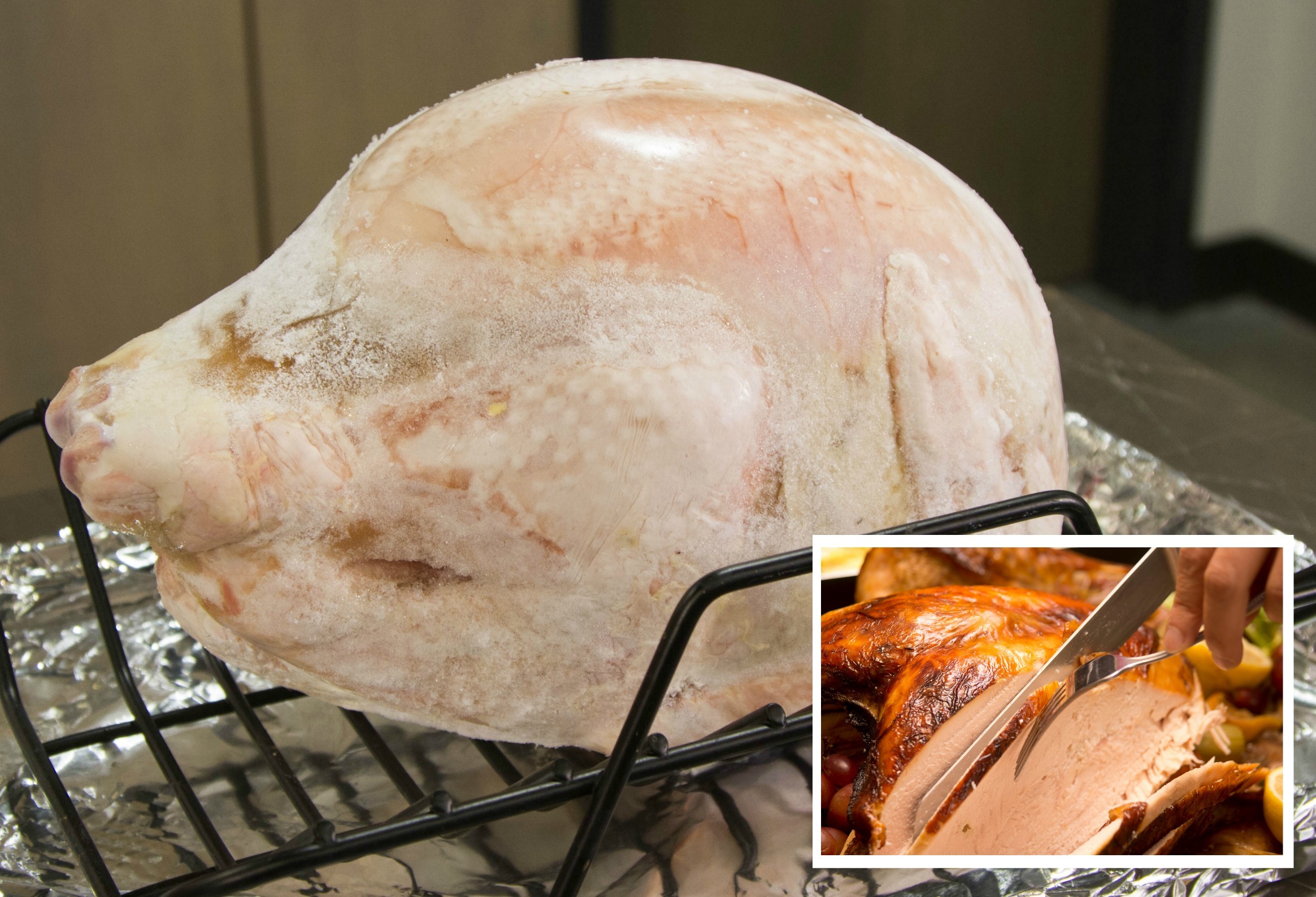
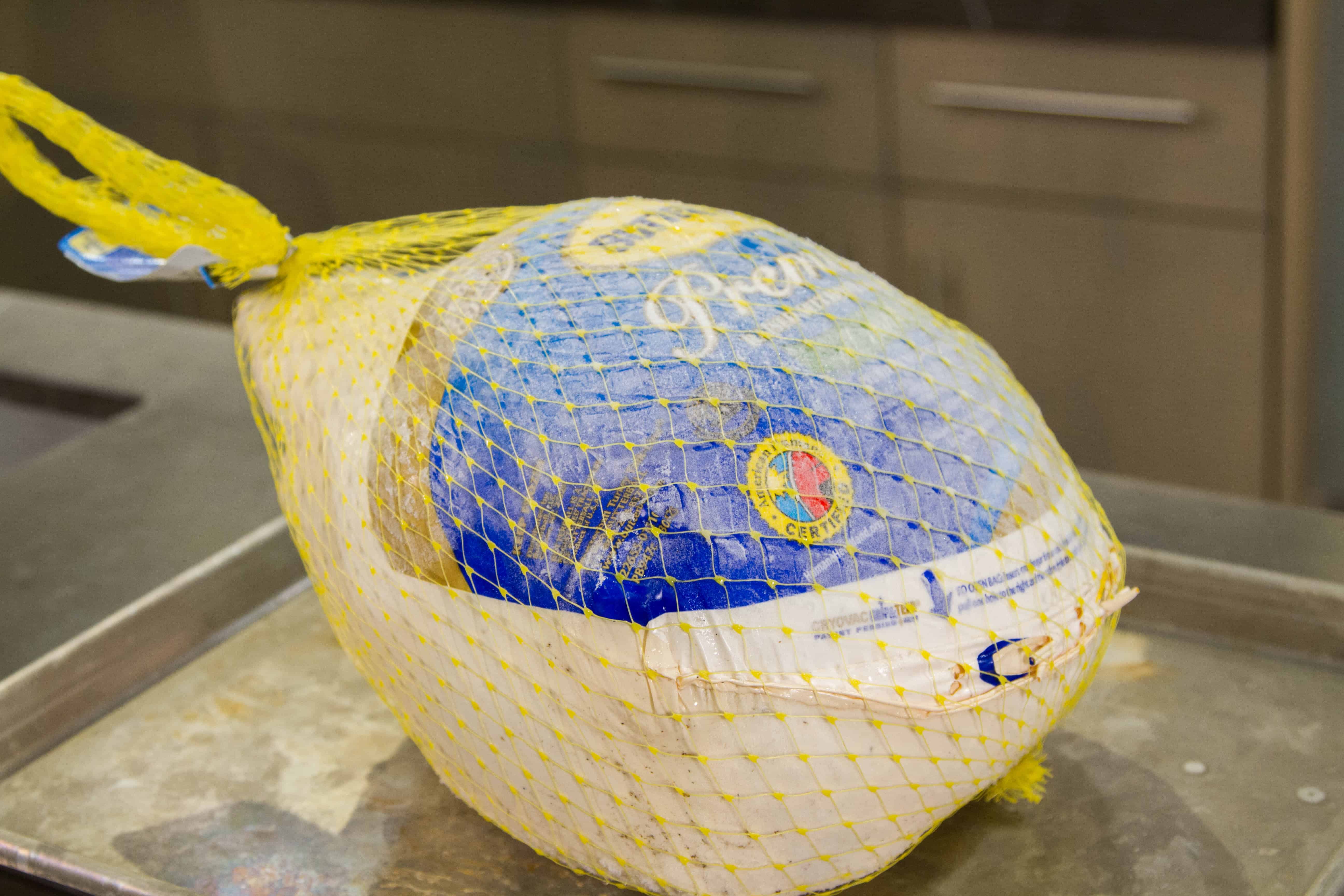
Remove the turkey from the wrapper and place on a v-shaped rack set over a sheet pan. Using a v-shaped rack is important to keep the frozen turkey from rolling around.
Start with a partial cook: a frozen-solid turkey is impenetrable. Seasoning won't adhere, the giblets and neck aren't going anywhere, and thermometer probes can't be placed. The turkey has to be partially thawed before proceeding with a recipe.
Cook the turkey at 325°F (163°C) for about 2 to 2-1/2 hours.
Once the first cook time is up, take a few temperatures in the turkey with an instant-read thermometer like Thermapen® ONE. At this point the turkey will have dramatic temperature gradients, still being partially frozen in some areas. The thigh will likely be in the range of 80–100°F (27–38°C), while the breast's temperature will be lower. If the thermal center of the breast meat is still frozen solid, return the turkey to the oven to cook it a bit longer until thawed enough to place the probe properly.
Once the breast meat is thawed enough to place a probe, remove the giblets and neck—the neck may still be surrounded by ice crystals.
Season the turkey as desired. We brushed the turkey with oil, seasoned with salt and pepper, and filled the cavity with aromatic vegetables and herbs.
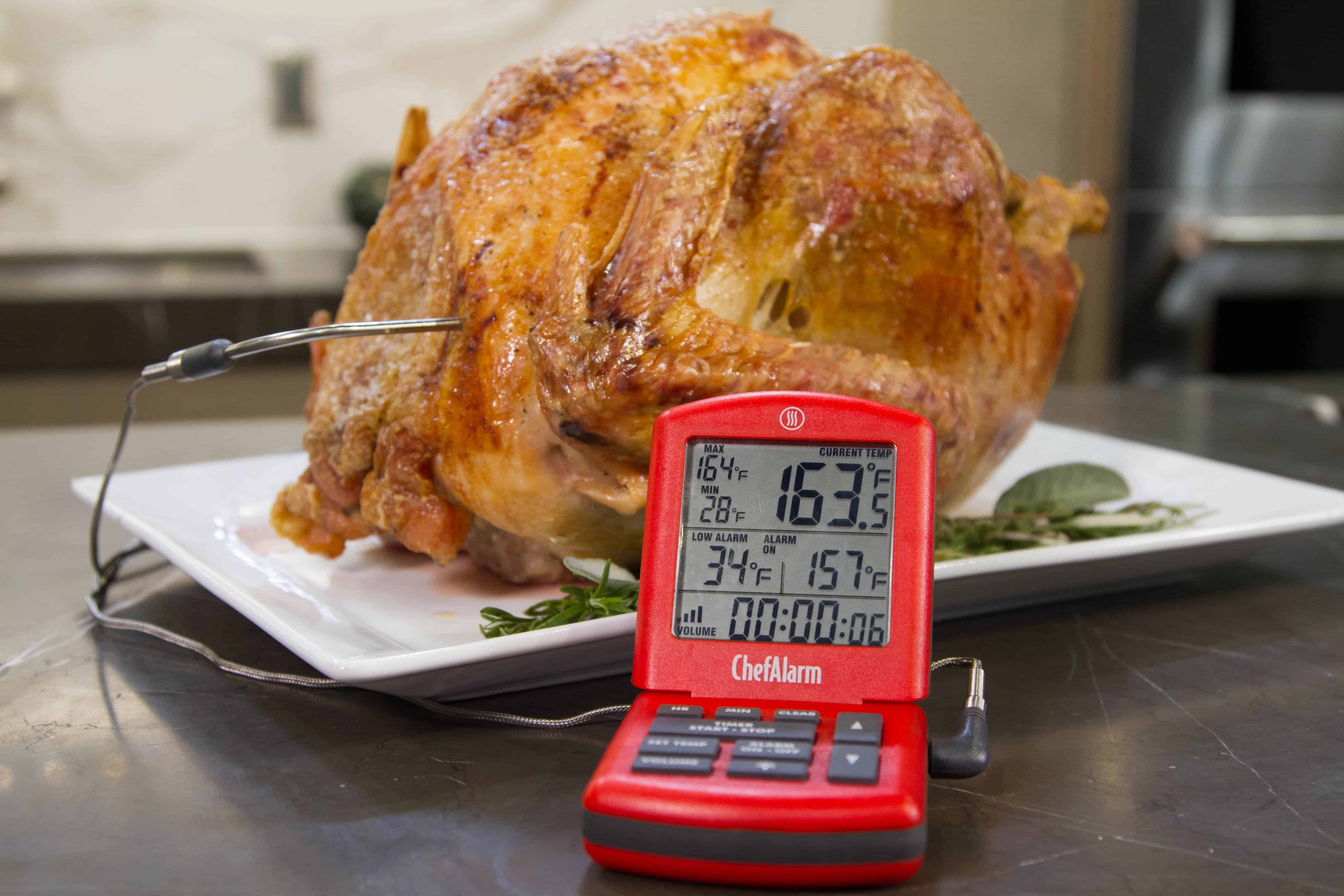
Place a Pro-Series probe, connected to your ChefAlarm, or RFX MEAT probe into the deepest part of the breast laterally from the side of the neck cavity, avoiding bone. Set the ChefAlarm's high alarm to 157°F (69°C). (See our post on Proper Probe Placement.) If you want to track the thigh temp, too, insert another RFX MEAT probe into the deepest part of the thigh. Set its high-temp alarm for 175°F (79°C).
Cook until the breast meat's internal temperature reaches 157°F (69°C) (about 3 to 3-1/2 hours longer). Pull the turkey from the oven when the thermometer's high alarm sounds, and spot-check the breasts and thighs (the dark meat should be about 170°F [77°C]) in multiple areas with a Thermapen ONE.
How to Properly Spot-Check Your Turkey’s Temperature
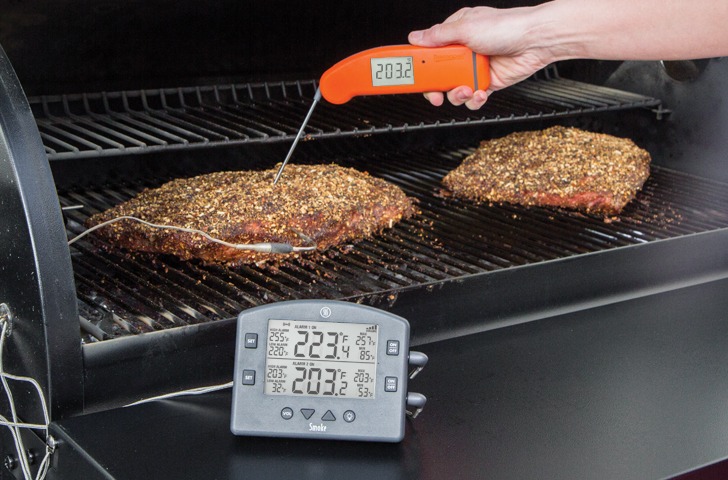
When spot-checking with an instant-read thermometer like a Thermapen, probe the meat from the top going past the thermal center, then pulling back up slowly. You will be able to see the temperature gradients from edge to edge in the meat. The lowest temperature found after multiple spot-checks is what you’re looking for.
If a lower temperature than 157°F (69°C) is found, re-place the leave-in's probe to read that lowest temperature area and return to the oven to cook until it reaches 157°F (69°C).
When the turkey's lowest temperature is verified at 157°F (69°C), pull it from the oven and allow it to rest, uncovered, for 30 minutes.
Martin is the Culinary Editor at ThermoWorks. After receiving a degree in physics and a graduate degree in the history of science, he went back to school for a classical culinary education. Having worked in the culinary world as cheese monger, baker, assistant butcher, prep cook, sous chef, and, eventually, executive chef. He believes temperature makes all cooking better, and better cooking makes for a happier life.
If we told you there was one culprit responsible for all the dried turkey you ever ate, would you want to find out what it was? And how would you feel, knowing that the culprit was operating under the guise of being a helpful friend? Well, folks, we have news for you. The culprit is…
Whether you’re frying chicken, doughnuts, or french fries, monitoring your frying oil temperature is key to achieve perfect results. Here are a few temperature tips so you know what oil temperature to fry chicken in as well as what internal temperature you should target while you do so. Oil Temperature for Frying Chicken: Pre-heat the…
We get this question a lot: “What kind of thermometer do I need?” The simplest answer is that you actually need two thermometers: 1) a digital instant-read and 2) a cooking alarm thermometer. Why two? Because they do different things. Two Kinds of Food Thermometers An instant-read thermometer allows you to quickly check the temperature…
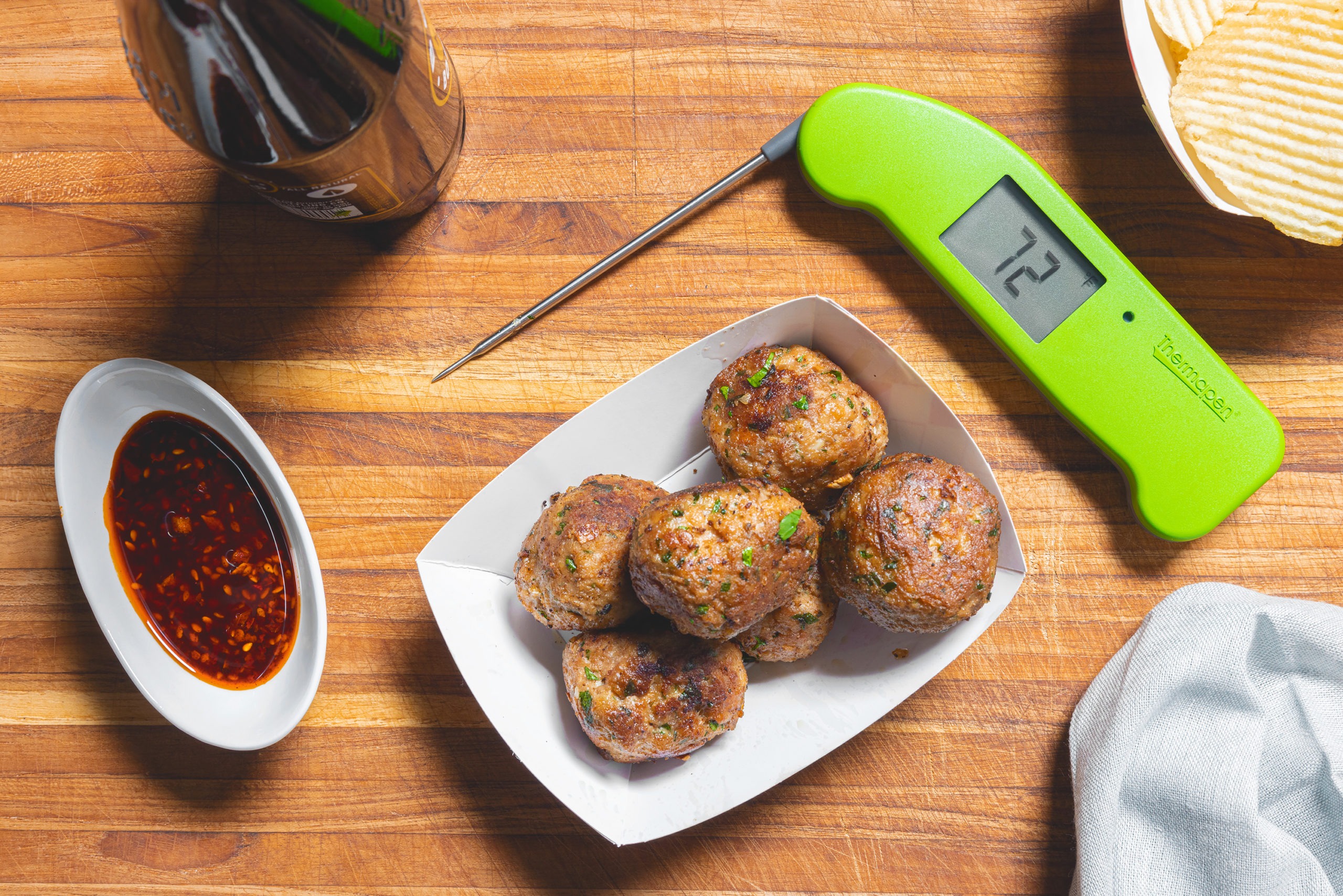
There’s nothing quite as easy to make that is so happily received at a game day get-together as a good meatball. In marinara, in BBQ sauce, wrapped in bacon, in a sandwich … meatballs and game-watching parties go hand in hand. Here, we want to share the basics of making quality meatballs from lean ground…
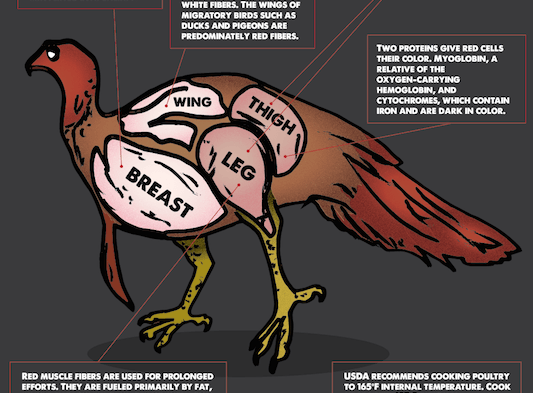
Have you ever stopped to considered why poultry has both white and dark meat, why the two taste different, and why they have to be cooked to different temperatures? Food Scientist Harold McGee says it has everything to do with the different kinds of muscle fibers and the particular kind of work that each is designed for.
34 Comments
What about the giblet bag and the neck ?? Doesnt that have to come out ????
Yes! Remove the giblets after the first 2-1/2 hours of roasting. Read through the post again. You’ll see directions to remove the neck and giblets in step 5, and also in a note “Start With a Partial Cook” just above step 3. After roasting for 2-1/2 hours the meat has thawed/partially cooked enough that you can easily remove the neck and giblets. That’s also the point when you season the turkey and place an alarm thermometer probe. It’s a fun method that can really get you out of a pinch!
A frozen chicken will work too. Apply the same steps to cooking your chicken. The cooking time will be the same—about 50% longer than a thawed chicken.
Big Green Eggs are quite versatile with their cooking temperature range. As long as the ambient temperature is 325°F throughout the cook, smoking is a great option! Happy turkey cooking.
What great information, had a turkey-less Xmas one year when my huge frozen turkey never defrosted after a week in my fridge-water-thawed it for Boxing Day,but it wasn’t the same.
Breasts are always too dry for me,so I am going to deliberately cook a frozen turkey this year.
Upside down 2/3 of the cooking time…in a turkeybag with 1 tbs of flour and slit a couple of holes on top of the bag. After 2/3 of cooking put another bag on outside the first bag, then turn the bird and make a slit on top of the bags.
Cook the last 1/3 of cooking. Never ever get dry turkey.
I’ve never cooked a turkey over a sheet pan before. My first thought is what about the copious amount of liquid it gives off? I don’t see anything in the write up about dealing with that. I assume you must be pulling juice off as you go with a baster. But then I picture myself constantly in and out of the oven and wonder how the oven temp keeps up with that.
Good question! When a whole turkey is roasted on a sheet pan without high sides or a lid there is enough surface area exposed that the liquid given off will evaporate at a rate fast enough that you don’t have to worry about it overflowing past the edge of the pan. The oven is only opened when the ChefAlarm’s high alarm sounds to verify the turkey’s internal temperature–no basting required.
Yes! Convection ovens have increased efficiency, and it is most often recommended to decrease the set oven temperature as specified in your recipe by 15-25°F.
I would like to try Sous Vide a butter ball turkey breast. Does anyone have any suggestions as to the temperature setting for the Sous Vide and for how long.
Thanks
I’m doing that this year. I set my sous vide to 157°F and use a probe thermometer inside the breast, once it hits 152°F I start a timer and hold it at that temp for a few minutes. The whole process takes 60–90 minutes, I seem to recall. We have a whole post on cooking sous vide turkey, check it out!
Hello, My turkey is 22lb and will be 100% frozen. I understand its 50% more for a cook so about 7 hours. My question is does the 2 and 1/2 hour pre-cook time still apply or is it longer, and then can i move into a diff pan to collect drippings for gravy but leave it on the V-rack?
What about using a turkey bag too? I was thinking of putting one on after the giblets are removed (2-2.5 hr mark). Would that shorten the baking time at all? Or make it moister?
It is my first Thanksgiving that I’m hosting/cooking everything, so it was very ambitious of me. This helped me feel a lot more confident about that ambition 🙂
I am unsure about quickening the bake, but I do know that it will not make it more moist. It will make it more wet, which is a different thing. Steaming hte bird in a bag will leave moisture on the surface, but will not keep it in the meat where we want it.
Don’t stuff the turkey! Stuffing turkey is a recipe for food-borne illness or dry turkey. The bread of the stuffing absorbs the raw turkey juices like a sponge, and by thte time you get the insulative bread cooked to temp to kill the bacteria in the juices, the meat will be overcooked.
Pingback: The Best Way to Defrost Turkey, According to Food Safety Experts - reviewer4you.com
I have a fully cooked smoked turkey that is frozen (about 8 pounds) can I defrost outside of fridge by tomorrow then heat on traeger or should I just cook from frozen?
Great question! The best roasting pan is actually a rimmed baking sheet. Yep, a regular old cookie pan is best. A deep roaster actually prevents hot air from getting to the thighs and legs as quickly, making the dark meat cook more slowly.


What about the giblet bag and the neck ?? Doesnt that have to come out ????
Patty,
Yes! Remove the giblets after the first 2-1/2 hours of roasting. Read through the post again. You’ll see directions to remove the neck and giblets in step 5, and also in a note “Start With a Partial Cook” just above step 3. After roasting for 2-1/2 hours the meat has thawed/partially cooked enough that you can easily remove the neck and giblets. That’s also the point when you season the turkey and place an alarm thermometer probe. It’s a fun method that can really get you out of a pinch!
Thanks!
-Kim
I’m going to try this with 20lb turkey. Hope it turns out
What about something smaller like a frozen chicken?
Bob,
A frozen chicken will work too. Apply the same steps to cooking your chicken. The cooking time will be the same—about 50% longer than a thawed chicken.
Thanks!
-Kim
What a fantastic write up. Nothing like having new avenues being opened to cooking things and it does allow the stretching of ones cooky experience.
Thanks,
bill
I would still smoke it on my Big Green Egg as I can achieve 325º easily. Kamados give extra flexibility.
Paul,
Big Green Eggs are quite versatile with their cooking temperature range. As long as the ambient temperature is 325°F throughout the cook, smoking is a great option! Happy turkey cooking.
Thanks,
-Kim
What great information, had a turkey-less Xmas one year when my huge frozen turkey never defrosted after a week in my fridge-water-thawed it for Boxing Day,but it wasn’t the same.
Breasts are always too dry for me,so I am going to deliberately cook a frozen turkey this year.
CA,
Let us know how your turkey cook goes tomorrow! Thanks for your comment.
-Kim
If your breast are dry, try cooking breast side down.
Upside down 2/3 of the cooking time…in a turkeybag with 1 tbs of flour and slit a couple of holes on top of the bag. After 2/3 of cooking put another bag on outside the first bag, then turn the bird and make a slit on top of the bags.
Cook the last 1/3 of cooking. Never ever get dry turkey.
I’ve never cooked a turkey over a sheet pan before. My first thought is what about the copious amount of liquid it gives off? I don’t see anything in the write up about dealing with that. I assume you must be pulling juice off as you go with a baster. But then I picture myself constantly in and out of the oven and wonder how the oven temp keeps up with that.
Mike,
Good question! When a whole turkey is roasted on a sheet pan without high sides or a lid there is enough surface area exposed that the liquid given off will evaporate at a rate fast enough that you don’t have to worry about it overflowing past the edge of the pan. The oven is only opened when the ChefAlarm’s high alarm sounds to verify the turkey’s internal temperature–no basting required.
Thanks for your question!
-Kim
Can you use a convection oven when cooking a fully frozen turkey?
CRM,
Yes! Convection ovens have increased efficiency, and it is most often recommended to decrease the set oven temperature as specified in your recipe by 15-25°F.
Thanks,
-Kim
I would like to try Sous Vide a butter ball turkey breast. Does anyone have any suggestions as to the temperature setting for the Sous Vide and for how long.
Thanks
I’m doing that this year. I set my sous vide to 157°F and use a probe thermometer inside the breast, once it hits 152°F I start a timer and hold it at that temp for a few minutes. The whole process takes 60–90 minutes, I seem to recall. We have a whole post on cooking sous vide turkey, check it out!
Thankyou!
.Here I was running cold water and thinking I was in trouble. I knew we’d likely not eat until 10PM.
Now my turkey is in the oven!
Thanks
Susan
Hello, My turkey is 22lb and will be 100% frozen. I understand its 50% more for a cook so about 7 hours. My question is does the 2 and 1/2 hour pre-cook time still apply or is it longer, and then can i move into a diff pan to collect drippings for gravy but leave it on the V-rack?
It will probably take longer for the first stage, yes. I’d give it 3 at least. Move forward with the cook once you can get a probe into the breast.
Thank you Martin, much appreciated.
What about using a turkey bag too? I was thinking of putting one on after the giblets are removed (2-2.5 hr mark). Would that shorten the baking time at all? Or make it moister?
A bag is unnecessary. It doesn’t actually make things more moist and will not appreciably speed your cook.
It is my first Thanksgiving that I’m hosting/cooking everything, so it was very ambitious of me. This helped me feel a lot more confident about that ambition 🙂
Can you also use a turkey bag, maybe after the first 2.5 hours? Would this quicken the bake time and make more moist?
I am unsure about quickening the bake, but I do know that it will not make it more moist. It will make it more wet, which is a different thing. Steaming hte bird in a bag will leave moisture on the surface, but will not keep it in the meat where we want it.
When I remove the giblets can I also stuff the turkey at that time?
Don’t stuff the turkey! Stuffing turkey is a recipe for food-borne illness or dry turkey. The bread of the stuffing absorbs the raw turkey juices like a sponge, and by thte time you get the insulative bread cooked to temp to kill the bacteria in the juices, the meat will be overcooked.
I have a fully cooked smoked turkey that is frozen (about 8 pounds) can I defrost outside of fridge by tomorrow then heat on traeger or should I just cook from frozen?
I’d cook it from frozen.
what is the best roasting pan to use for turkey
Great question! The best roasting pan is actually a rimmed baking sheet. Yep, a regular old cookie pan is best. A deep roaster actually prevents hot air from getting to the thighs and legs as quickly, making the dark meat cook more slowly.