
Inside Temperature Gradients: Getting to the Heart of the Thermal Center
We talk a lot about thermal gradients and the thermal center of foods, but what are those exactly, and how do they affect your cooking? Here, we’ll tell you what you need to know about this critical thermal concept and help you understand how you can use it to make your food better.
The concepts here will apply to every meat (really, to every food) you can make, but we’ll use a whole roasted turkey as our vehicle for the discussion.
What are temperature gradients?
When food cooks, heat moves from the outside in. Because of this, the outside of a turkey will be at a higher temperature, with lower temperatures as you move toward the center of the meat. This difference in temperature between the exterior and interior of the meat is referred to as a temperature gradient.
The gradients can be thought of as tree rings of temperature in the meat. Or more accurately, as layers in a jawbreaker. One key difference is that in thermal gradients, the layers are not distinct, they are, well, gradual.
The width of the total gradient depends on the cooking temperature.
When cooking anything, the higher the temperature you cook at, the larger the temperature gradient inside the meat. That is, turkey cooked at 450°F [232°C] will have a larger band of overcooked meat around its edges than turkey cooked at 250°F [212°C].
—The Food Lab’s Step-by-Step Guide to Smoking A Turkey, J. Kenji Lopez-Alt
Kenji talks about an overcooked band, and there will almost always be one. How overcooked it is, and how wide that band is, is a function of the cooking temperature and time. But if we pump a LOT of heat into the surface, it still takes time to distribute through the meat. Those gradients can stack up.
Understanding temperature gradients leads right into the core of where to place your thermometer’s probe: The thermal center.
The central point: The thermal center
The thermal center is the point in a turkey (or any cut of meat…or any food) furthest from the exterior that takes the longest to cook.
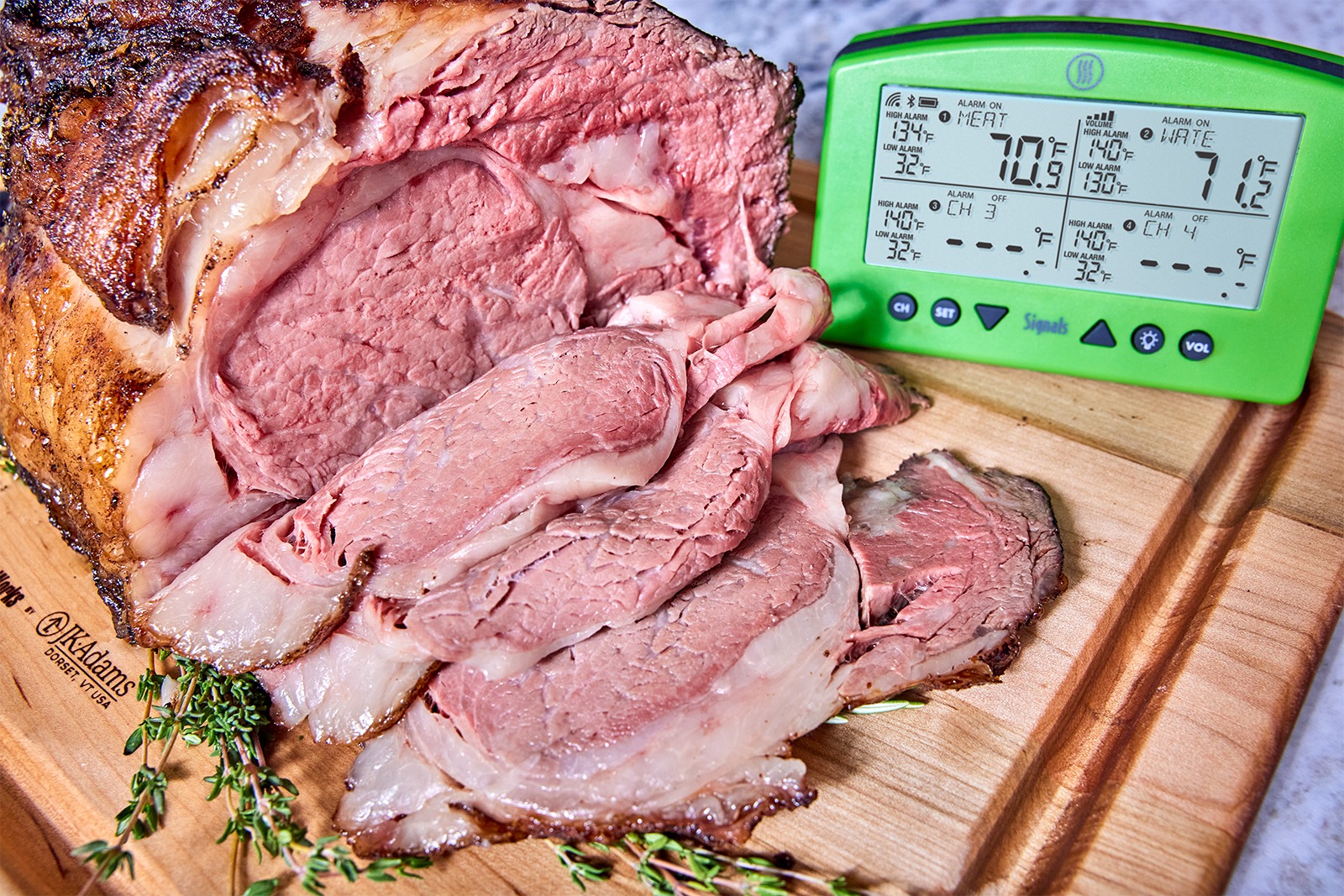
The largest mass of the turkey is its breast meat, and the deepest part of the breast in its thickest area is where the thermal center will be. In a cylinder-shaped roast like prime rib, it should be about halfway between the two ends, in the center of the cross-sectional circle.
This is where you want to put the sensor of your thermometer, because this will always be the least-cooked part of your food. And meat is only as done and safe as the least cooked part.

Know your probe: Understanding how sensor placement matters
For best results while using thermometers (a practice which we heartily endorse), you need to take the temperature at the thermal center. And to do that, you need to understand your thermometer’s probe. You need the part of the thermometer that is actually taking the temperature—the sensor—to be in the thermal center.
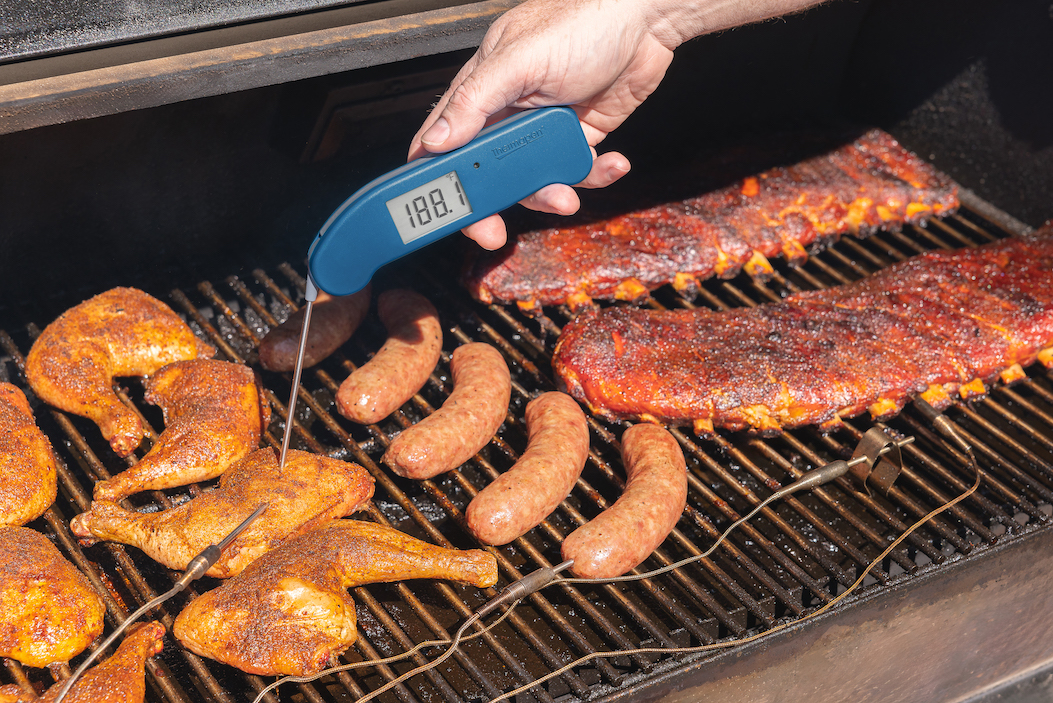
For a digital thermometer probe, like our industry-leading Pro-Series® probes, the sensor that needs to be in the thermal center is the tiny cone at the very tip of the probe. That tiny cone takes the temperature of such a small range of thermal gradients, so you know you’re getting a true temp in the center where you need it. The same is true for Thermapen® ONE—the very tip of the cone is the only part doing the temperature sensing. That’s why when you move your Thermapen through a turkey breast, you see rapidly changing temperatures—it’s reading all the gradients as you move through the meat.
It’s worth noting that this is physically impossible with an old-fashioned dial thermometer. The sensor in dial thermometers is an inch-plus-long spring that averages temperatures over the bottom length of the whole stem.
Understanding thermal gradients makes your cooking better
We said above that this knowledge makes your cooking better, but how? If you understand that heat moves in these stratified layers, you can better understand carryover cooking. If you understand the thermal center, you can always check that your food is perfectly cooked, without any surprises inside. And you can put all of that knowledge to use to create repeatably delicious food.
So, get your thermometers out and use them correctly to make something delicious today, and then again and again, perfectly every time. Happy cooking!
Meat temperature chart:
And to help you know what kind of temperatures you’re shooting for, here’s a handy chart of meat temps to aid you on your way.
| Ground Meat: Beef, Veal & Lamb* | 160°F (71°C) |
| Pork Ribs, Shoulders & Sausage (raw) | 160°F (71°C) |
| Ham (raw) | 160°F (71°C) |
| Ham (pre-cooked) | 140°F (60°C) |
| Egg Dishes | 160°F (71°C) |
| Chicken, Turkey & Duck (whole or pieces)* | 165°F (74°C) |
| Fish | 140°F (60°C) |
| Tuna, Swordfish & Marlin | 125°F (52°C) |
| Casseroles & Leftovers | 165°F (74°C) |