The Best of Both Worlds: How to Make a Turkey Both Golden Brown And Juicy
The eyes eat first. It’s a culinary axiom and it’s strikingly true. Plate the same burger a little nicer, charge $5 more, and people will say how worth it it was. It’s not cynical, it’s science. We’re not about to turn this blog into a how-to-plate platform, but there are places where our thermal interests mesh squarely with aesthetic demands. Take, for instance, your Thanksgiving turkey.
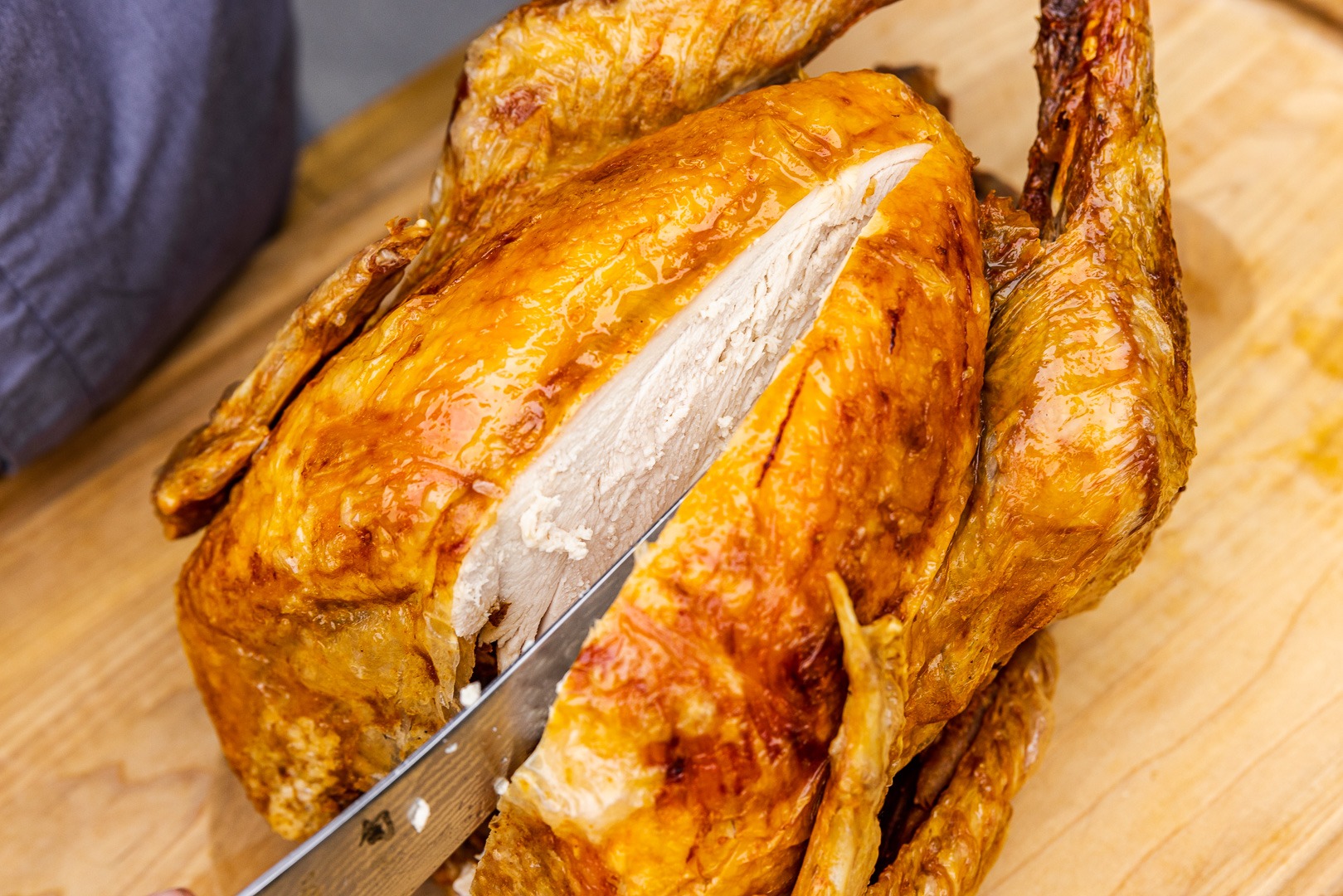
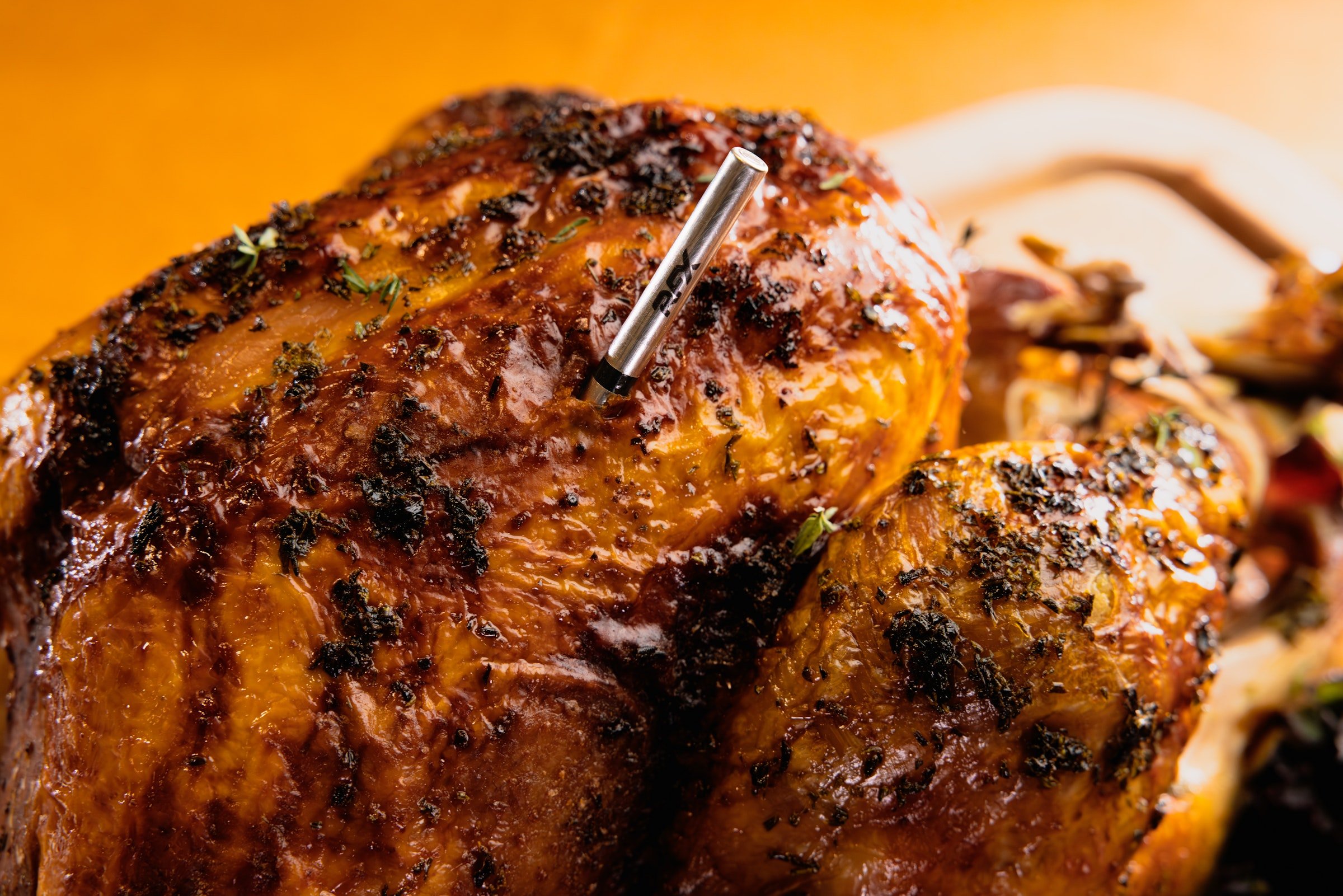
We’ve written extensively on turkey cookery, but it’s always been exclusively with a focus on tastebuds, rather than the visual appearance of the turkey. In this post, we’ll talk about how to cook a turkey that is beautifully golden brown—worthy not only of your family’s cravings, but also of whatever picture platform you choose to share your culinary triumphs with.
Of course, we will not abandon taste here. Any turkey can be made browner by overcooking it—we strive for a golden brown bird that is still juicy, tender, and delicious.

What makes a turkey brown?
The browning we see comes from a complex chemical reaction known as the Maillard reaction (pronounced MY-ar). The Maillard reaction is the same reaction that causes bread crust to brown, steak to become delicious, sweetened condensed milk to become dulce de leche, and bubbly cheese to taste so toasty.
In the reaction, certain kinds of sugars interact with amino acids in a low-water environment to create new chemicals.
The new large molecules that result then react and break down into hundreds of new molecules. Some of those molecules are melanoidins—large molecules with a brown color. And that is what we’re after, that is what makes turkey golden brown.
But it’s more than just brown
The Maillard reaction doesn’t just produce brown molecules; it also produces flavor molecules. Lots of them. Again, think of toast, toasted cheese, seared beef, coffee—all of these get their deep, cooked flavor from the Maillard reaction. Do we want that on our turkey? Yes we do!
So let’s look at how we can get more of it.
Maillard temperatures
Maillard browning happens at temperatures as low as room temp. In fact, this reaction is why soil is brown1.
But for the reaction to happen at a rate that is useful to us for cooking, we need to increase the temperature. The reaction rate picks up starting at about 230°F (110°C)2
but becomes much more noticeable at about 310°F (154°C)3
. So we’ll need to cook at temperatures at or above that mark.
Either way, it won’t hurt to make sure your oven is performing at the temperature it says it is. We periodically give our ovens a checkup with Square DOT® and make adjustments as needed, and recommend you do the same.
Paths toward a browner turkey: Maillard amplifiers
If we want a photo-worthy brown turkey, we need enough of the melanoidins to make it pretty, so we need more Maillard. There is one prerequisite and two main paths to create more of the Maillard reaction.
Prerequisite
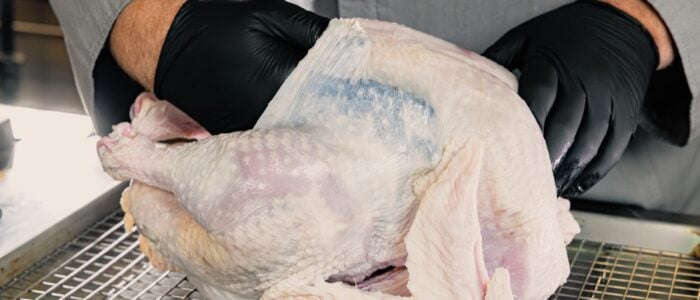
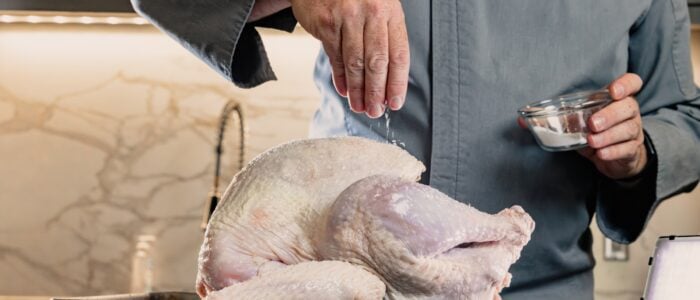
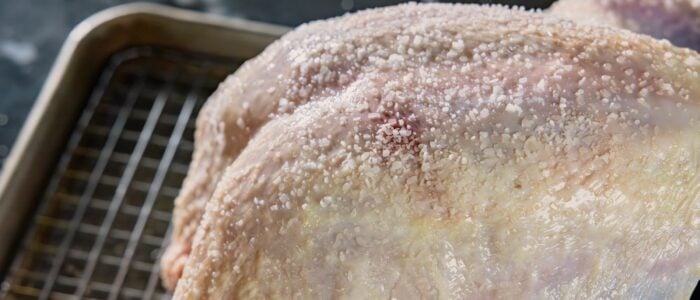
The prerequisite is a low-water environment. Wet turkey skin won’t brown, mostly because water is a temperature-limiting factor that keeps the skin from reaching the critical Maillard temps. So we need to make sure the skin is as dry as possible before the bird goes into the oven. We recommend dry brining your bird for dryer (browner, crisper) skin—among other reasons. Drying the skin in the oven shortens the available Maillard time, so it’s best to dry it before.
Two paths
As we said, there are two main paths toward deeper Maillard browning. They are
- Increasing the pH of the system, or
- Increasing the amount of available reducing sugars in the system.
Maillard browning happens faster and more in alkaline environments, so increasing pH can help. We have plenty of amino acids in the turkey protein skin, but only limited sugars. By making them more available, we can get more of the reaction.
Turkey browning path 1: Increasing turkey skin pH
When we considered how we could raise the pH, we came up with three options. First, adding baking soda to our dry brine. Baking soda is the most common kitchen base, so it seemed a great idea.
Next, baking powder. Yes, baking powder has acid and base, but on the whole, it yields a net higher pH.
These were the most promising and least strange methods we came across or could think of, so we decided to try them out.
Turkey browning path 2: Adding reducing sugars for browning
The technical bit
Before we talk about the sugar path, we should cover some basics on the kinds of sugars. We want reducing sugars, which are a class of sugars with certain chemical properties. Ask your chemist friends for more details, but reducing sugars can donate electrons to a carbon group because they have an aldehyde group or a ketone group. They change in alkaline solutions, which allows them to give their electrons away more readily. (That’s why increasing pH can affect Maillard browning.)
The reducing reaction is when they give those electrons away and make the receiving molecule more rich in electrons. It is the opposite of an oxidation reaction. So these sugars un-oxidize the amino acids.
All monosaccharides are reducing sugars, as are some di- and polysaccharides (sugars made of one sugar molecule, two, or more, respectively). Glucose and fructose are monosaccharides, so they’ll work. Lactose is a reducing disaccharide, as is maltose, but sucrose (table sugar) is not, so it won’t do any Maillard work.
So we can see another path toward browning: put some glucose, fructose, or lactose on our turkey. Maltose could work, but it’s not readily available in any common household ingredients. Glucose is easy to find—the corn syrup Grandma had in her cupboard is mostly glucose. Fructose will behave much like glucose in this experiment, so we’ll just use glucose. Lactose we can get from milk, obviously, or powdered milk. We’ll try both.
Testing and results
We started out testing with two (properly thawed) turkeys, each dry-brined with 1 tsp salt per pound of bird. After dry brining but before cooking, each bird was brushed with melted butter and had melted butter rubbed up under the skin to increase crisping. (SeriousEats recently tested crisping methods, and their findings show that pubber really does help to crisp the skin.)
First, we wanted to determine which had a greater effect: pH or sugar. We started with two birds and prepared one half of each bird differently:
Bird 1:
- Left side: dry brined with the addition of ¼ tsp baking soda per pound of bird.
- Right side: dry brined with the addition of ¼ tsp baking powder per pound of bird.
Bird 2:
- Left side: dry brined with the addition of ¼ tsp nonfat milk powder per pound of bird.
- Right side: control, just dry brined.
We chose milk powder for Bird 2 because lactose is a reducing sugar, and we were concerned about sweetening our bird with corn syrup.
pH modifier results
We were, frankly, shocked at the results. Apparently, the pH of a turkey is already in a good place, because the pH adjustors didn’t promote any extra Maillard browning. And even if they had, the metal/soap flavors left behind by the baking soda and powder were not a welcome addition to our hypothetical Thanksgiving feast.
Modifying pH was not our path to a better turkey.
Milk powder results
The milk-powder half of our turkey showed significant browning compared to our control half. In fact, it got a little too brown in some spots, moving past tasty and into acrid.
We wondered if we could achieve better results with less powder, but we also wondered if the milk powder’s amino acids in combination with the reducing sugars made a difference. Yes, turkey skin is chock-full of amino acids, but were we just browning the milk solids instead of the turkey proteins?
So we decided it was time to try the syrup.
Round 2: Basting our turkey…with corn syrup!
In round 2, we tested a more restrained version of milk by lightly dusting half a turkey with powdered milk after adding the dry brine salt. We also brushed the other half with whole milk before adding the salt for the dry brine.
For the second turkey, we left half of it as control (just dry brined then buttered before cooking), and brushed the other half with corn syrup, diluted with water in a ratio of 1:5 (1/4 C corn syrup plus 1-1/2 C water).
Were we worried about making a candied turkey? Yes. Did we need to be? No.

Round 2 results: milk vs corn syrup
The lightly-dusted milk powder was a good play, as was the milk. Both had nice browning that was better than our control, and the milk powder wasn’t as over-strong as in the first test.
But the corn syrup…wow. The line between our control half and our corn syrup half was like night and day—almost literally! The browning difference was stark. But what really impressed us was the lack of sweetness.
Remember above, where we said that browning = flavor? We weren’t wrong. The toasty-meaty-roasty flavor in the skin, and even in the meat, was definitely more pronounced. And when we cooked another turkey to verify our results, we noticed that the smell of the roasting bird had so much more of those same notes. It put the smell of other turkeys to shame. There was no sweetness, only deep savoriness.
Summary of findings: Brown turkey principles
After testing several turkeys, here’s what we learned.
First, juiciness matters, so temperature matters. You can’t rely on long cooking to brown your bird because it will end up dry. A leave-in probe like our RFX MEAT™ Wireless Thermometer or ChefAlarm® can track the temps in your meat and help you take it out before it dries. Set the high-temp alarm on your thermometer for 155°F (68°C). If that seems low, you should read about how to cook a turkey right! Trust us, it will be both juicy and safe to eat.

Adjusting the turkey skin’s pH has little to no effect on Maillard browning.
Adding a source of reducing sugars was extremely effective, and the source that worked the best was a thin solution of 1 part corn syrup in 5 parts water. We brushed that onto the turkey before we applied the salt for the dry brine. This resulted in a turkey that was much more savory, without a trace of sweetness, and deep, lovely brown color.
But my Grandma didn’t baste her turkey with corn syrup…
In Norman Rockwell’s famous painting, Freedom From Want, Grandmother holds what appears to be a 27-pound turkey that has been roasted to a deep, dark brown. That image, now part of the collective American psyche, is partly responsible for the way we view a perfect turkey today. But that turkey was probably cooked for about six hours. So, no, it didn’t need a boost to the Maillard browning; it got plenty of it in the oven. And it was probably dry.
With our modern understanding of how proteins behave and the availability of high-precision thermometry, we no longer cook our turkeys like that. If we want that level of browning, we just don’t have the time, unless we give the reaction a little…push.

Well-browned, juicy turkey—give it a try
For a turkey that is worthy of a modern Rockwell painting, and worth eating, give this method a try. We think you’ll love it, and we think your family will, too. Happy cooking!
Note on convection ovens
We created this recipe to be as accessible to as many readers as possible, so we didn’t use a convection oven in our tests. But if you have one, you will get more even browning if you use it. Some of the nooks and crannies near the bottom of the turkey—where all the juices drip and accumulate—are very resistant to browning. The wind of a convection oven forces hot air into those spots better, drying and browning them.
Sources:
Jeff Potter, Cooking for Geeks, pg. 205
Sandra C. Greer, Chemistry for Cooks, pg. 185
J. Kenji López-Alt, The Food Lab, pg. 292
Simon Quellen Fiels, Culinary Reactions, pg. 172–173