

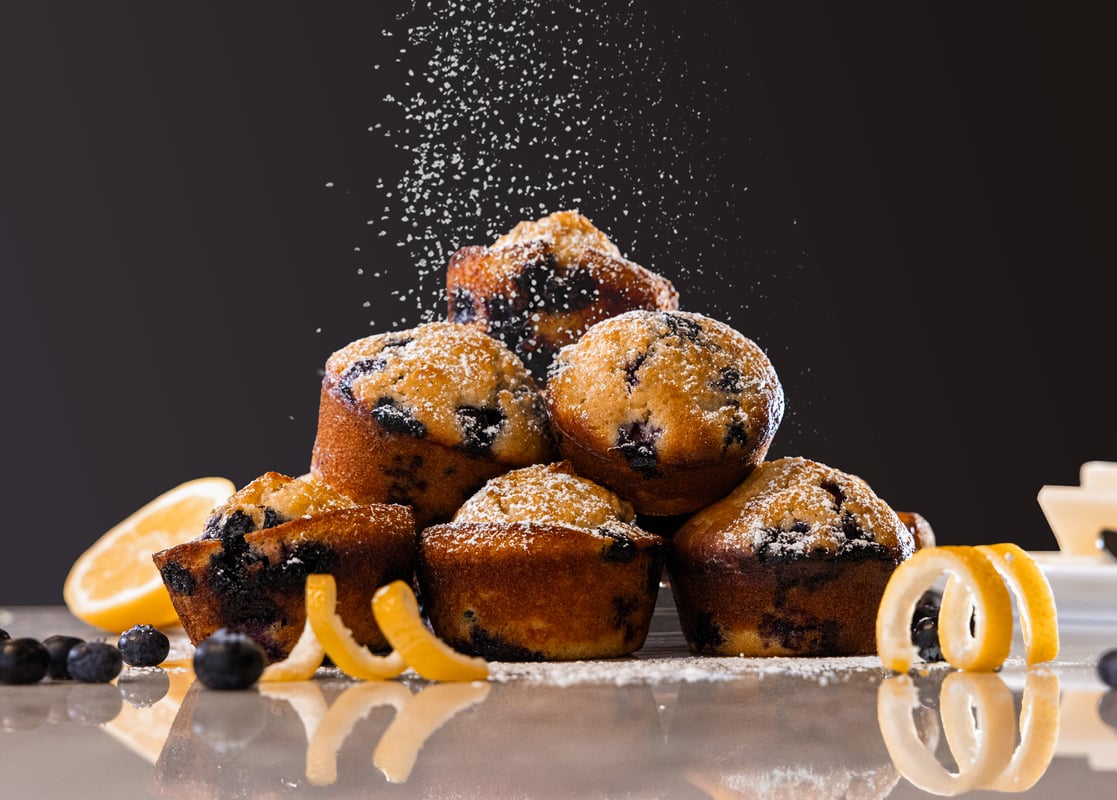
The Best Blueberry Muffins: Recipe and Temperatures
Who doesn’t love a blueberry muffin? As sweet treats go, they’re delightful whether for breakfast or a quick snack, on the go. Let’s look at what it takes to make them better.
With school starting and a general change in season, we’re looking ahead to changed schedules and a return to more indoor cooking. Whether you’re putting little ones back in backpacks or just adjusting to a new feel in the air, having a quick, delicious breakfast on hand is a great idea. Homemade blueberry muffins fit that bill perfectly.
Muffins freeze well, scale up easily into larger batches, and are better homemade than store-bought. Let’s look at how to make fluffy, soft, delicious muffins for you and your crew.
Get the gear for this cook here:



Muffin background and history—what is a muffin?
The term muffin is derived from the old French word moufflet, which meant soft. And the name is apt. Whether we’re talking about English muffins or the kind that we, in America, usually think of, they are certainly soft little breads. American muffins are usually sweet and are leavened with baking powder.
Muffins are important enough to commercial baking that in cooking school, students are taught the “muffin method”. In the muffin method, you…
- Mix your dry ingredients together
- Mix your wet ingredients together
- Mix the two together gently, and let them rest for a few minutes
That may seem like a common-sense approach to making a batter, but it is an important basic method. In fact, its importance is probably why it seems so commonplace—you’ve encountered it so much already, without knowing what it is.

Homemade blueberry muffins—worth it?
You have a busy life. Is it worth it to make your own muffins? Yes! Homemade muffins are far better than the ones from the store. Those ones are often overly sweet, dense and heavy, and smack of preservative chemicals that don’t taste great. Using fresh (or frozen) blueberries to make your own muffins in your own kitchen is well worth your time, and will save you plenty of money, too!
For perfect texture, don’t overmix
Muffins should be soft, like the name implies—not chewy or tough. To achieve that tender crumb, avoid overmixing the batter. Overmixing produces more gluten, which makes the muffins bouncier, tougher—chewier. The batter will be somewhat lumpy when you are done mixing.
Professionals check their muffins by breaking one in half from pole to pole and looking for air channels that tunnel upwards through the muffin. If the muffin is tender enough, those don’t form. Not that your 5th grader will notice. But if you’re trying to perfect them, that’s something to look for.

Are muffin cups necessary?
While they are often served in paper muffin cups, when we make them at home, we prefer to leave them off. A well-buttered muffin tin is just as effective, and you get a tastier crust on the bottoms. Plus, there’s no weird paper trash to throw away, and you don’t lose any pastry to the paper.

Blueberry muffin temperatures
Muffin baking temp
The temperature at which you cook your muffins depends on how you want them to look when they’re done. The classic, low-dome muffin cooks at 350°F (177°C)—a respectable temperature that will move the muffin through all the baking stages at a good rate.
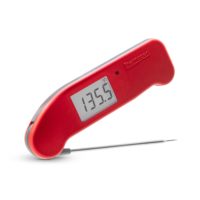
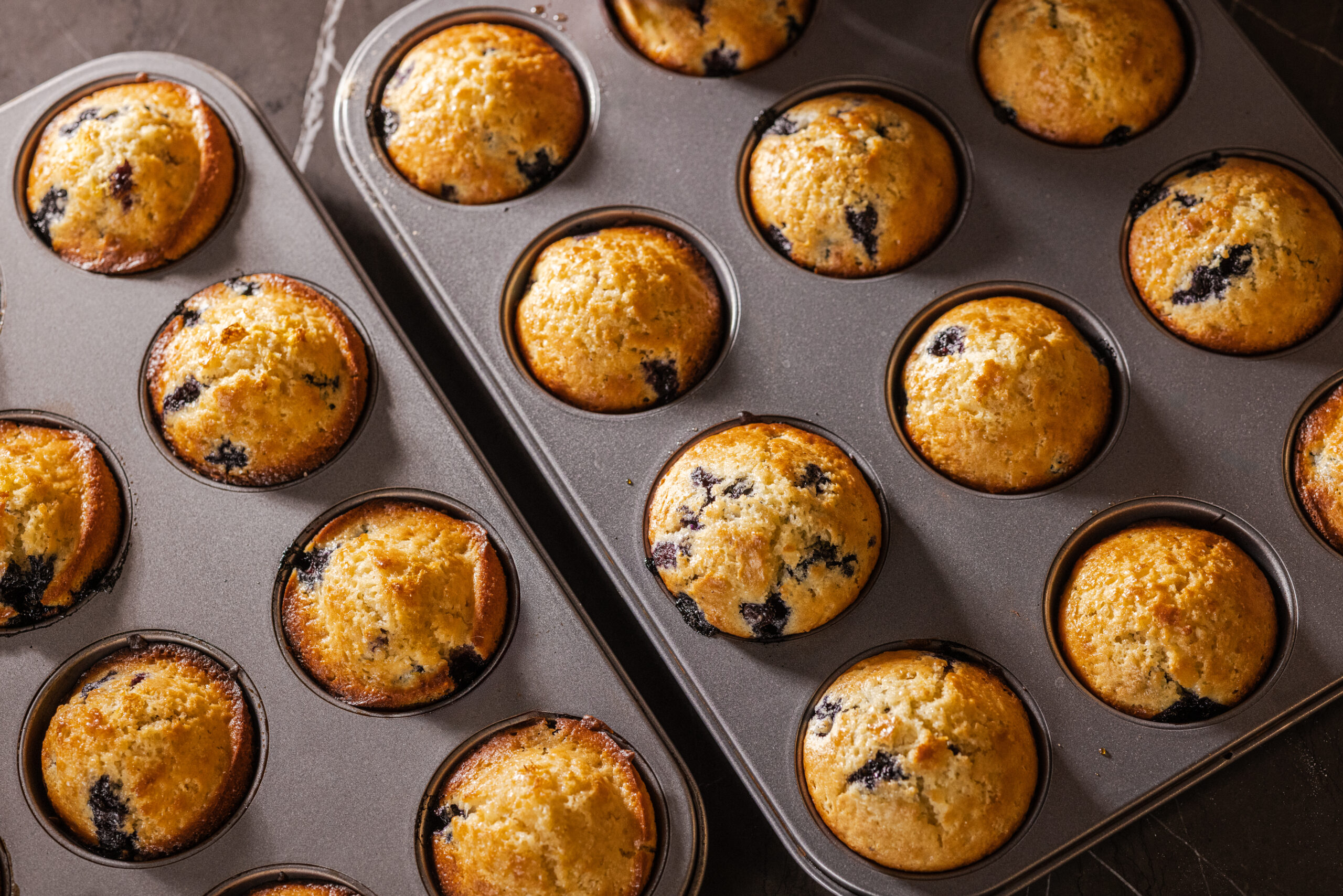
But if you want taller, pointier muffins (like we made for this recipe) that vaguely resemble gnome hats, you want to start them out at a higher temperature. Put them into a 425°F (218°C) oven for 5 minutes, then turn the heat down to 350°F (177°C) for another 10–15 minutes. Use a good timer that you can hear if you walk away to set the 5-minute timer, or you’ll burn your muffins! Oh, and be sure to carefully open and shut your oven door when you make the temperature change to vent a little hot air.
That high temperature right at the beginning of the cook creates more steam and more leavening right at the beginning, before the muffins can set up. This pushes the dome of the muffin up higher, and you end up with taller muffins. It’s an aesthetic choice, but one that you can choose to make if you want!
Muffin doneness temp
A tender, moist muffin is a breakfast treat, a dry one that you have to choke down is almost a punishment. Cook your muffins to temperature, not just time, to avoid that. After all, your recipe doesn’t know how your oven acts!
Muffins fall under the “quick breads” category of baked goods, which means they have a doneness temperature of 200°F (93°C). Use your Thermapen® ONE to take the temperature of one of the center muffins in the tin when your timer goes off. If it’s not hot enough throughout, keep cooking. If it’s there, or maybe a degree or two shy, pull them out. (There will be some carryover cooking.)

On muffin pan color and muffin color
If you use a darker colored pan, you’ll get darker colored muffins. Darker colored pans absorb more wavelengths of light, including infrared radiation, which translates to more heat. Think of when you wear a black shirt in the sun vs. a white shirt—you feel more baked in the black one, and your muffins feel the same.
If you use the higher-top muffin method with the hotter oven and a dark-colored pan, you’re going to have more browning on the muffins. That’s not a bad thing, but be prepared for it!

Make these muffins!
Homemade muffins—especially these ones—put store-bought muffins to shame. And they’re really very easy to make. Make a batch–or two…or three—this weekend and enjoy them for breakfast, snacks, and treats throughout the week. Check their doneness with Thermapen ONE and you’ll know they’ll be moist and perfect. Happy cooking!
(The Best) Blueberry Muffins Recipe



Ingredients
- 8 oz all-purpose flour by weight
- 5 oz sugar by weight
- 2 tsp baking powder
- ½ tsp salt
- 2 eggs
- 1 C milk
- 4 Tbsp melted butter
- 1 tsp vanilla
- 5 oz blueberries fresh
- 1 Tbsp lemon zest
Instructions
- Preheat oven to 350°F (177°C) and grease your muffin tin. (Or, for taller muffins, preheat to 425°F [218°C])
- Mix your dry ingredients together in a bowl. Set aside.
- In a separate container, mix the liquid ingredients (eggs, milk, melted butter, vanilla) and lemon zest.
- Stir the liquid mixture into the dry ingredients, stirring gently until just mixed—the batter should still be somewhat lumpy.
- Carefully fold in the blueberries with a silicone spatula.
- Portion the batter into the muffin tin.
- Now bake. If you are cooking at 350°F the whole time, cook for about 18 minutes. If going for taller muffins, cook at 425°F for 5 minutes, then turn the heat down to 350°F, gently open and close your oven door, and continue cooking for about 10 more minutes.
- Check the internal temperature with your Thermapen ONE—it should be 200°F (93°C).
- Remove the muffins from the oven. Cool for 5 minutes before removing from the pan. Serve warm with soft butter or cool and store!


A question: is the 8 oz flour 1 cup or 1/2 pound? Same for the sugar?
Thanks for clarification; looking foreward to trying these.
Those units are by weight.
? The flour and sugar, is that weight or liquid measured? Thanks
Those are by weight.
It’s a tasty recipe. Should be noted that 1X makes 12 (not 24) regular sized muffins.
I fixed that in the recipe, thanks for the heads-up.