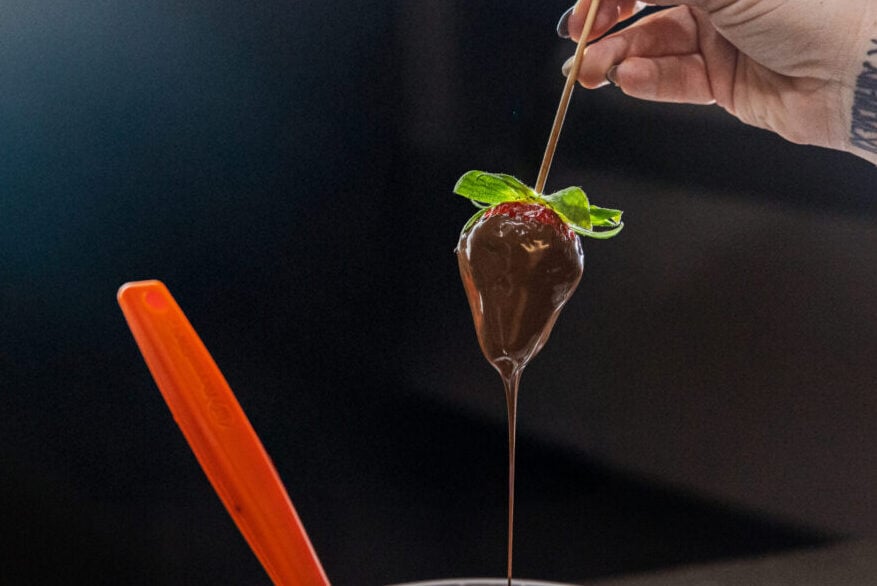
Chocolate-Dipped Strawberries and How to Temper Chocolate Perfectly
How to Make Chocolate-Dipped Strawberries at Home
Tempering chocolate feels intimidating, but really, it’s heating chocolate slowly to the right temperature. No matter what chocolate you are “melting,” you should measure the temperature to ensure that you get a beautiful set finish, rather than a chalky, uneven finish.
Tempering chocolate isn’t guesswork — it’s temperature work. The difference between glossy, firm chocolate and dull, soft chocolate often comes down to just a few degrees.
That’s where a Thermapen® ONE makes all the difference.

Unlike inexpensive digital thermometers that can lag or overshoot, Thermapen ONE gives you:
- Instant, accurate temperature readings in ≤1 second
- Easy-to-read display at any angle
- Precise control through every stage of tempering
- Ability to measure chocolate temperature directly without touching the bowl
When you’re working with narrow windows like 80–82°F for cooling milk chocolate, you want confidence, not guesswork.
And paired with a Hi-Temp Silicone Spatula, you’ll keep chocolate moving gently and evenly, without scorching or clumps.
Why Tempering Chocolate Matters for Chocolate-Dipped Strawberries
Tempering chocolate stabilizes the cocoa butter crystals, so the chocolate:
- Sets firm at room temperature
- Looks smooth and glossy
- Snaps cleanly when bitten
- Doesn’t melt immediately in your hands
Without tempering, chocolate-dipped strawberries may look fine at first, but they’ll turn dull, streaky, or soft as they sit.
Temperature control is the difference between professional-looking strawberries and chocolate that never quite sets.

Tempering Chocolate with Thermapen ONE: Temperature Guide

Different chocolates have distinct working ranges. Below is the chart we used to hit the perfect temperature every time.
| Chocolate Type | Melt To | Cool To | Working Temp |
|---|---|---|---|
| Dark | 113–122°F | 82–84°F | 88–90°F |
| Milk (Used Here) | 104–113°F | 80–82°F | 86–88°F |
| White | 104–113°F | 78–80°F | 84–86°F |
Tip: Use Thermapen ONE to verify every stage not just the final temperature. That’s how professionals avoid bloom, streaks, or grainy chocolate shells.
Tools You’ll Need
- Thermapen ONE
- Silicone spatula
- Heat-safe bowl
- Saucepan or microwave
- Parchment paper
- Fresh strawberries
1. Prep Strawberries First
Wash and dry completely. Water is chocolate’s enemy.
2. Melt the Chocolate
Place chopped chocolate in your heat-safe bowl. If using a double boiler, gently heat and stir. If microwaving, use short bursts and frequent stirring.
Use Thermapen ONE to confirm the chocolate reaches the melt range (e.g., 104–113°F for milk chocolate).
3. Cool With Control
Remove from heat and stir gently with your silicone tool. Use Thermapen ONE to watch the chocolate fall into the cool range (e.g., 80–82°F milk chocolate).
4. Reheat to Working Temp
Gently warm back up using careful heat. Monitor with Thermapen ONE until you land in the working window (86–88°F milk chocolate).
5. Dip and Set
Use a dipping stick or hold the strawberry by the stems, dip, and set on parchment. No shock cooling. Let the chocolate set at room temperature.
Quick Tests to Know You’re on Track
Glossy Chocolate?
- Yes → Perfect temper
- No → Likely overheated or moisture introduced
Sets Firm in 3–5 Minutes?
- Yes → You nailed the working range
- No → Chocolate needs re-tempering

Bottom Line
Great chocolate-dipped strawberries aren’t luck — they’re temperature and technique. With Thermapen ONE in hand and the right temperature windows for dark, milk, and white chocolate, you’ll consistently hit glossy shells with satisfying snap — every time.
Chocolate Tempering Problems and How to Fix Them (FAQ)
Yes. Chocolate tempering requires temperature precision. Guessing or estimating leads to dull, soft chocolate.
Moisture, even steam or condensation, can cause sugar to seize. Dry tools and dry fruit, and confirm temps with the Thermapen ONE.
Not right away. Cooling too fast creates condensation, dulls the chocolate, and affects snap.
This typically means the chocolate wasn’t properly tempered or never reached its correct working temperature. Use an instant-read thermometer to confirm the final dipping temperature before coating strawberries.
Dull chocolate is a sign that the cocoa butter crystals didn’t stabilize correctly. This often happens when the chocolate is overheated or cooled too far before reheating.
Yes. Simply re-melt the chocolate back to the melt range for its type, then cool and reheat it following the proper tempering temperatures.
Yes. Milk and white chocolate are more sensitive to temperature changes and require tighter control than dark chocolate. Small temperature swings can push them out of temper quickly.
Absolutely. High humidity introduces moisture into the air, which increases the risk of seizing and bloom.